
Emergency Garage Door Repair Near Me: What Nampa Homeowners Should Do First
A garage door frozen halfway open isn’t just inconvenient – it’s an open invitation. But grabbing the emergency release cord while the door sits off its tracks is one of the fastest ways to turn a modest cable repair into a panel-and-cable job. Here’s the order that actually protects your door, your security, and your wallet. If you’d rather not deal with any of it yourself, call (866) 942-7318 and we’ll take it from there.
The five minutes between a failure and your phone call matter more than most people realize. Do the right things in the right order and you contain the damage. Do them in the wrong order and you create a second problem on top of the first. We’re going to walk through that sequence – what to check, what to touch, and what to leave completely alone.
Key Takeaways
- Stop operating the door the moment something sounds wrong. Repeated cycles cause most secondary damage.
- Never pull the emergency release cord while the door is off its tracks or under spring tension.
- Secure a stuck-open door with what you already have – a clamp, a cinder block, a bungee – before you do anything else.
- Describe the failure accurately on the call so the right parts come on the first visit.
- Ask about pricing and response commitments before you agree to anything.
What Should You Check First When Your Garage Door Fails in Nampa?
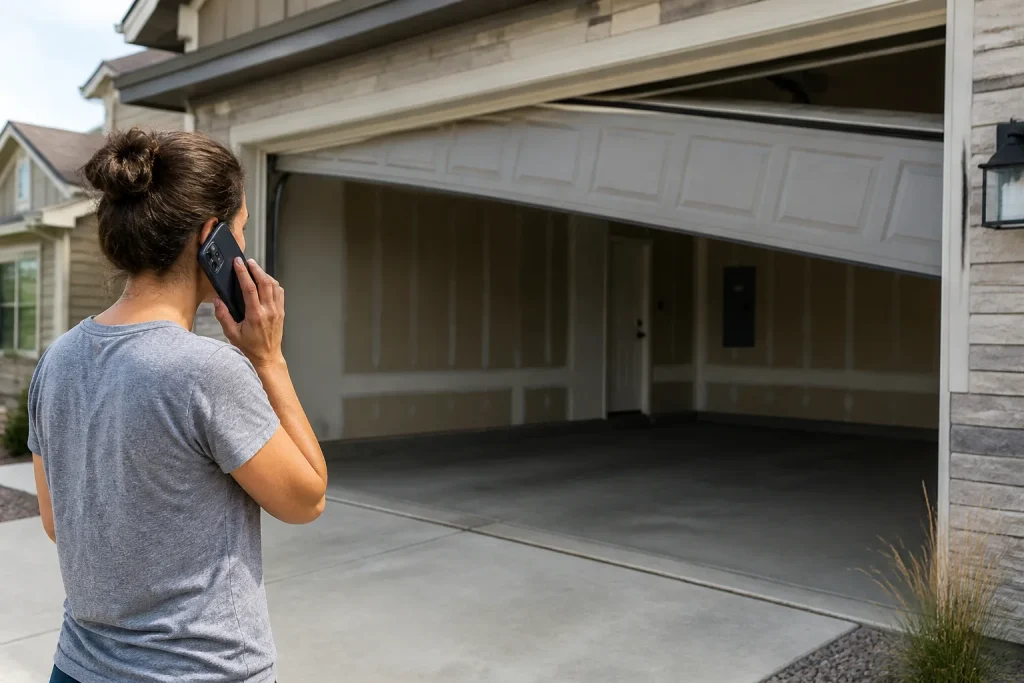
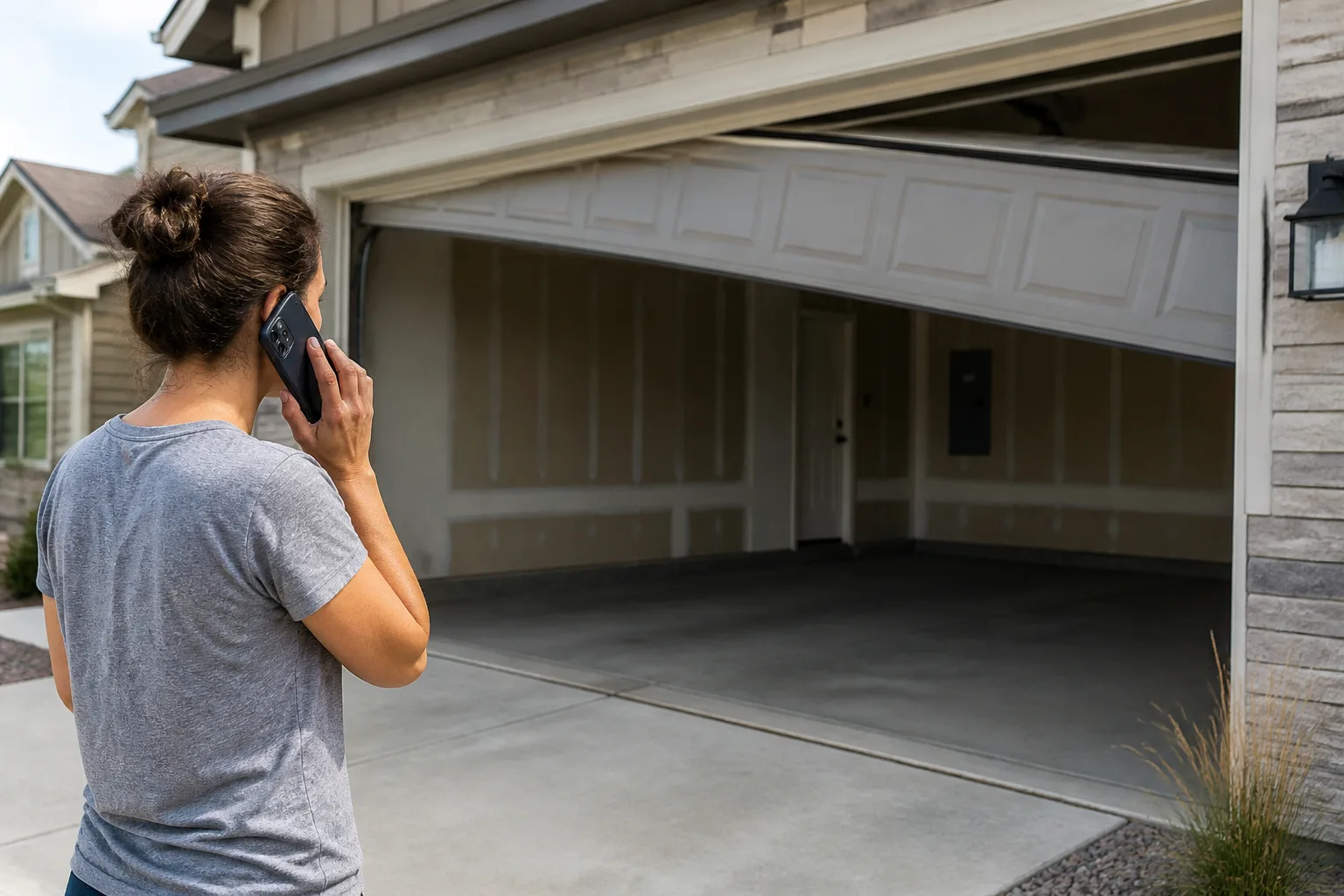
Check whether the door has physically left its tracks before you touch anything else. A door that’s crooked, hanging off one side, or visibly out of the vertical rail is in structural failure – that changes everything that comes after. In Nampa, where doors cycle hard through hot summers and cold winters, track and roller wear shows up more often than people expect. The metal expands and contracts season after season, and a roller that’s been slowly degrading can drop out of the rail with no warning.
Work through this order, ranked by risk rather than convenience:
- Stop pressing the button. Every cycle on a damaged door risks bending a panel or snapping a cable. This is the single most important step and the one people skip.
- Look at the door’s alignment. Is it level? Are the panels lined up? Is there a visible gap on one side?
- Look at the tracks. Are the rollers seated inside the rail? Is the track bent, dented, or pulling away from the frame?
- Listen before you look. A snap or bang before the failure usually means a spring or cable let go. That’s a different repair than a grinding noise, which points to rollers, bearings, or the opener.
- Leave the springs and cables alone. Torsion springs are under extreme tension and can cause serious injury. Never attempt to adjust, remove, or “test” them yourself. That’s a job for a trained technician, full stop.
If the door is off its tracks, don’t try to force it back on. A track that’s been pushed out of alignment usually needs to be re-secured and realigned properly, and forcing a heavy door back into a bent rail can warp a panel or drop the whole door. Park the car outside the garage, keep the door where it is, and make the call.
How Do You Secure a Stuck-Open Garage Door While You Wait?
Secure a stuck-open door from the inside by wedging it, blocking the opening, and locking the entry door between the garage and the house. Most homeowners already have everything needed in the garage itself. This isn’t about restoring function – it’s about restoring basic security until a technician arrives.
Here’s the no-tools approach we’d walk any Nampa homeowner through:
- Close the interior door. If your garage connects to the house, lock that door. It’s your first line of defense and takes two seconds.
- Block the door’s travel. Slide a sturdy object – a cinder block, a heavy box, a stack of paving stones – under the bottom edge where it meets the floor. This prevents an unexpected drop if the door is being held by a failing spring.
- Clamp the track. A C-clamp or a locking pliers clamped onto the track just above a roller stops the door from sliding further down. If you don’t have one, a tightly cinched bungee cord around the track and roller does a surprising amount of work.
- Cover the opening if you can’t block it. If the door is stuck near the top, the opening is exposed. Pull a vehicle up close to the opening, or hang a tarp across the gap from the inside. It won’t stop a determined person, but it removes the “wide open garage” signal that invites trouble.
- Don’t leave it overnight open if you have valuables inside. Move what you can into the house, and if the situation allows, call us before the sun goes down so you’re not sitting on an open door after dark.
None of this fixes the door. It just buys you time without adding to the problem. We answer 24/7, and fast dispatch from 7am to 7pm gets a technician on the road during the day.
When Should You Pull the Emergency Release Cord?
Pull the emergency release cord only when the door is fully closed, the springs are intact, and you simply need to disengage the opener to open the door by hand. In that narrow case it’s a useful feature. In every other case – door off its tracks, door stuck halfway, spring broken, cable snapped – the cord makes the problem worse.
Here’s why. The release cord disconnects the door from the opener’s trolley. On a healthy door, that lets you raise it manually. On a door whose springs have failed, the door has no counterbalance – it’s dead weight, often a few hundred pounds, held in place only by the opener. Pull the cord and that weight comes down. On a door that’s already off its tracks, pulling the cord removes the last thing keeping it from crashing down or swinging sideways and bending a panel.
We’ve seen it play out often enough to say it plainly: on a Genie or Chamberlain opener alike, the cord is not a universal “unstick” button. Match the tool to the failure. If you’re not sure what failed, assume it’s a spring until a technician tells you otherwise, and don’t touch the cord.
If you’re confident the failure is opener-side – the motor runs but the door doesn’t move, or the door reverses immediately – see our page on garage door opener repair. That’s a different diagnosis than a structural door failure, and the safety steps are different too.
How Should You Describe the Failure When You Call?
Describe what you heard, what you saw, and what you didn’t touch. A specialist who knows the failure mode can bring the right springs, cables, or rollers on the first visit instead of diagnosing blind in your driveway. The details below are what actually help – not a guess at what’s wrong.
Have these ready before you dial:
- What you heard. A loud snap or bang before the door stopped (spring or cable) versus a grinding, squealing, or humming noise (rollers, bearings, opener motor).
- The door’s position at failure. Fully closed, fully open, halfway, or crooked on one side.
- Whether the opener still runs. Does the motor hum or click but the door sit still? Does the door move a few inches and reverse?
- Door and opener brand. LiftMaster, Chamberlain, Genie, Clopay, Amarr, Wayne Dalton, Craftsman, or Raynor – we work on all of them, and knowing which helps us load for the job.
- Door material and rough size. Steel, wood, or aluminum, and a single or double door. Approximate measurements are fine.
- What you’ve already done. Tell us if you pulled the release cord, tried to lift the door, or clicked the button a few times. Honesty here saves time.
Our technicians have up to 12 years of experience, and they’ve learned that a customer who describes a “sharp snap then dead weight” is almost certainly looking at a broken torsion spring, while “it grinds and stops halfway” usually points to rollers or a track issue. That kind of detail lets us show up prepared.
What Does a Reputable Emergency Garage Door Response Actually Look Like in Nampa?
A reputable response means an honest statement of availability, a free estimate, and a written price agreed before any work begins. Anything less is a warning sign. Nampa is a growing city with a lot of doors, and not every outfit that advertises garage door repair treats the job the way a dedicated specialist does.
Here’s what to ask before you say yes to anyone:
- “What’s the response window?” A straight answer beats a vague one. We answer 24/7, and fast dispatch from 7am to 7pm Sunday through Friday. We’re closed Saturday.
- “Is the estimate free and in writing?” The price should be quoted and agreed before any work starts. If a company can’t tell you that on the phone, keep looking.
- “Are you specializing in garage doors, or is this one of many trades?” A single-trade specialist diagnoses faster because they’ve seen the same failure modes hundreds of times. A general handyman treats a garage door as a sideline.
- “Can you source parts for my brand?” A company that only handles one product line may leave you waiting. We work on eight major brands, so recommendations follow your situation, not a manufacturer’s incentive.
- “What’s the total, and what’s the emergency dispatch fee?” There’s no dispatch fee. The written estimate is the price.
Bait-and-switch operators tend to dangle a low number and add charges once they’re in your driveway. A straightforward company will tell you on the call that the price is set by the written estimate after diagnosis. That’s how it should work.
For a broader look at what a typical repair involves and what drives cost, see garage door repair.
What Are the Most Common Failure Modes, and Which Are True Emergencies?
Most garage door failures in Nampa fall into a handful of categories. Some are true emergencies – the door is open, off its tracks, or unsafe to leave. Others are inconvenient but not urgent, and you can wait for a scheduled visit without stressing. Knowing which is which helps you decide whether to call for same-day service or book a measurement appointment.
True emergencies to call on right away:
- Broken torsion spring. The door is dead weight, often halfway up, and you can’t safely move it. Do not pull the release cord.
- Snapped cable. The door is uneven or tilted. It’s structurally compromised and unsafe to operate.
- Door off its tracks. The door is crooked, hanging, or wedged, and any further movement risks panel damage or a fall.
- Door stuck fully open. It’s a security exposure, and the outside is now an open invitation.
Inconvenient but not urgent, so schedule it:
- A noisy door – squealing rollers or a groaning opener.
- A remote or keypad that doesn’t work when everything else does.
- A door that reverses on its own when closing, if your safety sensors are the likely cause.
- A slow opener, or a motor that’s starting to strain.
One thing we’d gently push back on: a stuck door isn’t always a “same-day” call, and a new door is never one. If the diagnosis points to a door at the end of its life – bent panels, a warped frame, a motor on its last legs – the right next step is a free measure and a written price, not a rushed repair. A garage door repair can only take a door so far; sometimes replacement is the honest answer, and we’ll tell you that if it is.
When Should You Call a Pro Instead of Trying to Fix It Yourself?
Call a pro anytime the door is off its tracks, the springs or cables are involved, or the door is heavier than you can safely lift. Springs and cables are the two components in a garage door system that can cause serious injury – they carry enough stored tension that a mistake is not worth the risk, no matter how handy you are. That’s not a sales line; it’s the short version of why we don’t give step-by-step DIY instructions for those parts.
The things you can safely do yourself: close the interior door, block the doorway, clamp the track, and call. Resetting a tripped breaker or re-aiming a safety sensor is fair game if the opener is the only thing that failed. Anything involving torque, tension, or lifting the door is not.
Our technicians have up to 12 years of experience working on doors and openers from Clopay, Amarr, Chamberlain, and Genie, and they’ll tell you honestly whether you’re looking at a repair or a replacement. Garage doors are all we do, and that focus shows in the diagnostic.
Related services in Nampa: if you’re not sure whether the door or the opener is the problem, our garage door opener repair page covers the motor, sensor, and remote side of the equation. For a broader look at who we are, see Nampa Garage Door Service.
How Do You Protect Your Door After the Fix?
Protect the door after the fix with a simple monthly check – run it up and down, listen for new noises, and look at the tracks and rollers. Nampa’s swing between hot summers and cold winters is hard on moving parts, and small things caught early stay small. Once a season, wipe the tracks clean, check that the safety sensors at the bottom are clear of cobwebs and debris, and listen for a change in the sound. A door that starts to grind or squeal is telling you something.
And when a failure does happen, remember the order: stop pressing the button, check alignment and tracks, secure the opening, then call. Five minutes done in the right sequence often keeps a modest repair from becoming a much bigger one. If you’d rather hand it to a specialist, we’re here.
The Bottom Line
A garage door emergency is a sequence, not a scramble. Stop operating the door, check whether it’s off its tracks, secure the opening with what you have, and describe the failure accurately when you call. Don’t pull the release cord unless the door is closed, intact, and you only need to disengage the opener. And when you do call, ask about the response window and the written estimate before you agree to anything. Our technicians are ready when you need them.
If you’re in Nampa and need help, Nampa Garage Door Service offers free estimates – call (866) 942-7318. We answer 24/7. Fast dispatch from 7am to 7pm, Sunday through Friday, closed Saturday. The price is quoted and agreed before any work starts.
Frequently Asked Questions
There’s no flat emergency rate – the price is set per job by the written estimate after a technician diagnoses the failure. A straightforward cable or roller repair sits at a lower price point than a broken torsion spring or a door that needs to be re-tracked, and we quote and agree the price before any work begins. Call (866) 942-7318 for an exact quote – estimates are free.
In most cases, yes. We answer 24/7, and fast dispatch from 7am to 7pm, Sunday through Friday, gets a technician on the road during the day. A call outside dispatch hours is booked into the next opening. Call (866) 942-7318 and we’ll tell you what’s available.
No – the written estimate sets the price, and we agree it with you before any work starts. A technician may find additional damage once the door is opened up, but that’s a conversation and a revised written estimate before anything is done, never a surprise on the invoice.
Yes – our technicians are experienced, licensed, and insured, and they specialize in garage doors only. We work on eight major brands, including Clopay, Amarr, Chamberlain, and Genie, so we can diagnose across the brands in your driveway. Call (866) 942-7318 for a free estimate.
Written by the team at Nampa Garage Door Service.
Need Garage Door Help?
Call Nampa Garage Door Service - licensed & insured, here with fast help in Nampa.
(866) 942-7318